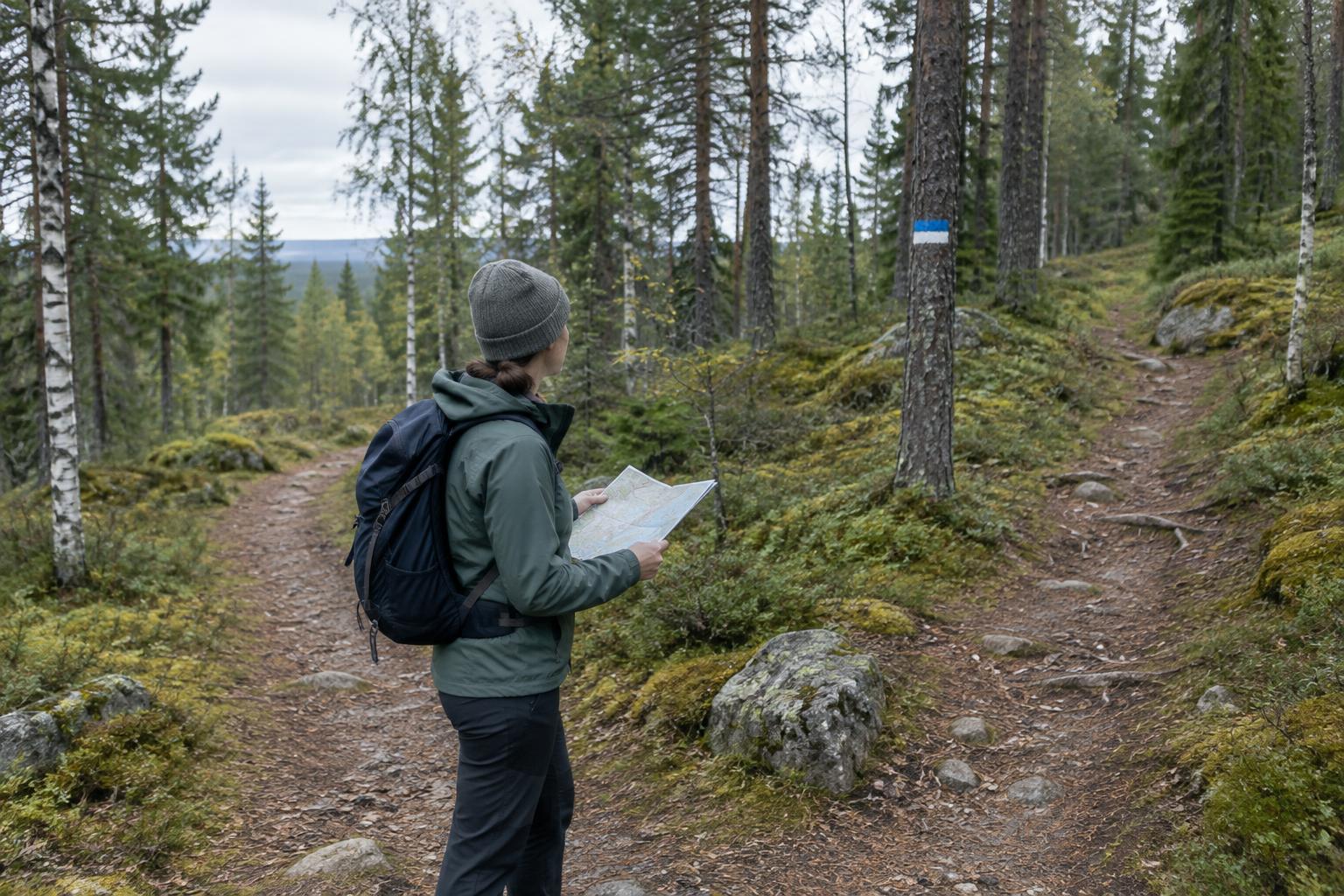
Start with the route, not the paint
Trail markers are most useful when you already know which trail you intend to follow. Before setting out, look at a current park map or route description. Note the trail name, its colour or symbol if it has one, major junctions and where the route ends. Check whether the path is a loop, an out-and-back walk or part of a larger trail network. A photo or offline copy of the map can help when reception is unreliable.
Also note how much daylight you expect to have and whether the route has an obvious point where you can turn back. Bring footwear suited to the ground, water and an extra layer when conditions call for them. A marked path can still cross exposed, muddy or uneven terrain; the markers show a route, not a guarantee that it will be comfortable in every condition.
Recognise the markers used on your trail
A marker might be a painted blaze on a tree, a coloured disc, an arrow on a post, a carved symbol or a sign bearing a trail name. Some routes use small cairns in open terrain. There is no single marking system that applies everywhere, so check any legend or guidance provided at the trailhead. Colours may distinguish routes within one area, but the same colour can mean something different elsewhere.
Look for markers at a natural walking pace, especially where the path becomes faint. They are often placed where they can be seen from the intended direction of travel, which means a marker may be harder to spot when you walk the route in reverse. Take time to look back occasionally and notice what the return journey would look like. Avoid adding paint, moving signs or building your own cairns: informal markings can confuse other walkers.
Treat every junction as a decision point
At a fork or crossing, slow down and identify all the available paths before choosing one. Compare the sign or marker with your map and the trail name you noted at the start. An arrow may indicate a turn, while a marker farther along a branch may confirm that you chose correctly. Rather than walking a long distance on an assumption, continue only far enough to look for that confirmation.
Watch for places that feel like junctions but may not be part of your route: a wider track, a shortcut through vegetation or a worn path to a viewpoint. The most obvious-looking way is not necessarily the marked way. If your route changes trail names partway through, note the change in advance so that an unfamiliar sign does not send you back unnecessarily. When walking with others, pause together at junctions so nobody follows a different branch.
Keep confirming your position as you go
Following a marked route is a series of small checks, not one decision made at the trailhead. Notice landmarks such as a bridge, a stream crossing or a distinct bend, and compare them with the map when possible. After a turn, look for the next marker without assuming that every post or painted tree belongs to your trail. Markers may be spaced farther apart on clear stretches and closer together where the direction is less obvious.
A phone map can be a helpful second check if it has been saved for offline use, but batteries run down and a location dot may not settle precisely on a narrow path. Carrying a paper map, where available, gives you another way to orient yourself. Keep either map accessible rather than waiting until you are unsure to unpack it. If the path ahead seems inconsistent with your route description, stop and check before pressing on.
If the markers disappear, stop and retrace
Missing one marker does not always mean you are off route. It may be hidden by growth, placed around a bend or absent from a short, clear stretch. But if the path splits, becomes indistinct or leads somewhere you did not expect, stop. Look around from a safe position, check the map and recall the last marker or junction you confidently identified. If you can safely retrace your steps to that point, do so and reassess from there.
Resist the urge to cut across unfamiliar ground to meet the trail where you think it should be. A direct-looking shortcut can lead to steep ground, fragile vegetation or another unmarked path. If you cannot establish your position or return safely, stay together if you are in a group and use the assistance options available in that area. A calm pause and a short backtrack are usually more useful than continuing to walk while uncertain.


