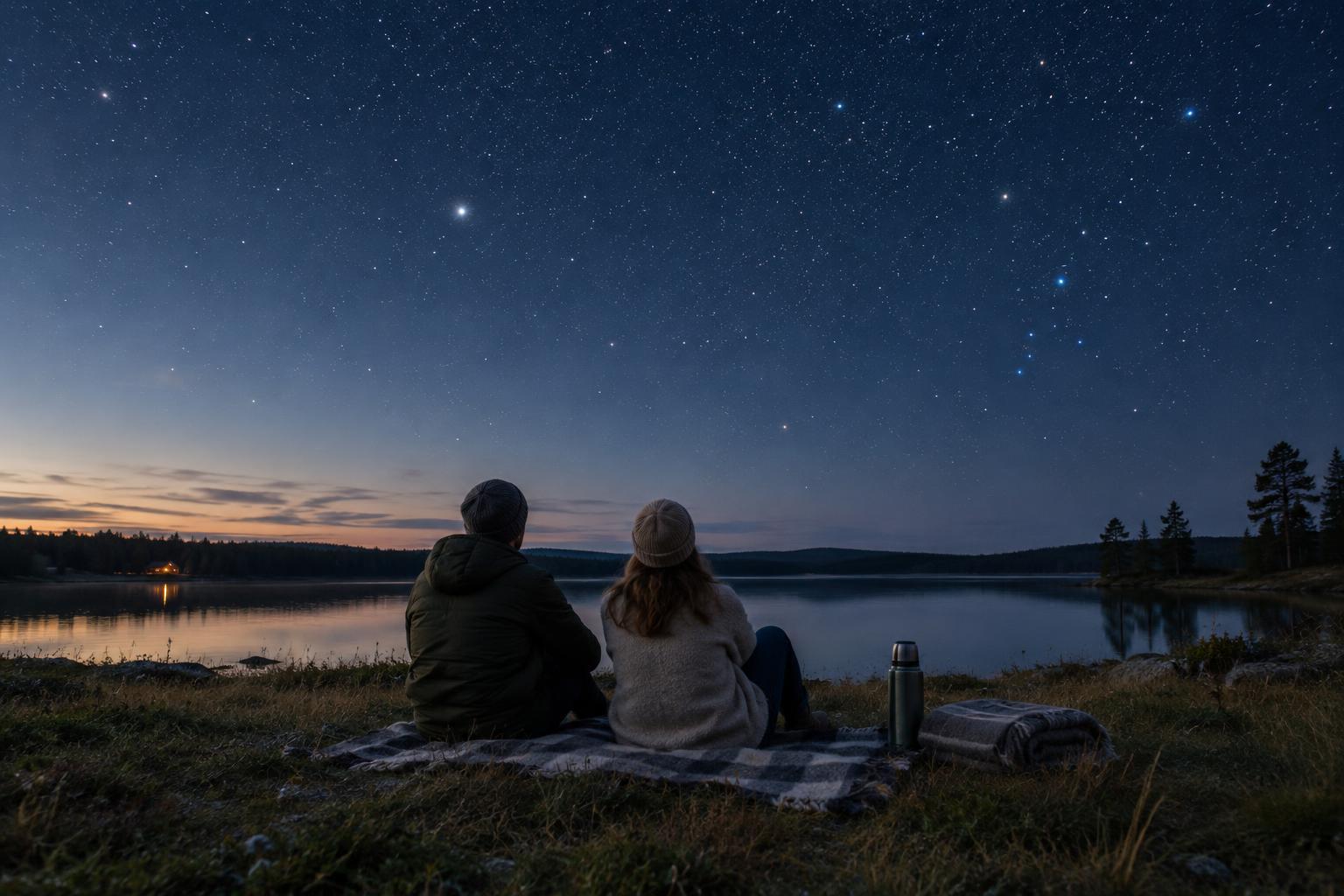
Start with a place you can enjoy
Stargazing begins with looking up, not buying equipment. A clear view of the sky from a garden, balcony, park or familiar walking route can be enough for a first outing. You may see more away from bright streetlights and buildings, but the best starting place is one where you feel comfortable and can stay for a while. Check that the location is open after dark, and avoid entering private land or unfamiliar terrain.
Look at the weather before you go. Thin cloud can hide faint stars even when the sky does not look fully overcast. It also helps to think about the Moon: its light makes many dim stars harder to see, while the Moon itself is an inviting subject when it is visible. There is no need to wait for perfect conditions. A short session from home can teach you what your local sky looks like.
Get comfortable, then give your eyes time
Choose clothing for the temperature you will feel while standing or sitting still, rather than for a brisk walk. A warm layer, comfortable shoes and something dry to sit on can make the difference between heading inside quickly and lingering long enough to notice more. Keep paths and steps in mind if you are moving around in the dark.
Once outside, let your eyes settle. Bright phone screens, porch lights and car headlights can interrupt your adjustment to the dark, so turn your screen brightness down or put your phone away for a while. If you need a light to walk safely, use one; seeing where you are going matters more than preserving night vision. When you stop, try looking across a broad area of sky instead of searching immediately for a particular object. More stars may become noticeable as you spend time outside.
Find a few landmarks instead of memorizing the sky
Begin with whatever is easiest to recognize: the Moon, a bright star, or a distinctive pattern of stars. Constellation patterns can serve as landmarks, but their visibility changes with your location, the season and the time of night. A printed sky chart for your area can help, though you can also simply observe the same patch of sky on several evenings and notice what becomes familiar.
Pay attention to direction. If you know where the Sun set, you have a rough sense of west; a compass can help if you want greater certainty. From there, notice whether a bright point is low near the horizon or high overhead, and which nearby stars form a shape you might remember. You do not need to identify everything correctly on the first night. Recognizing one pattern and finding it again is a satisfying start.
Notice what changes and what stays steady
The Moon is especially rewarding to revisit. Its visible shape changes over successive nights, and its position in the sky will not always be the same when you step outside. Bright planets may also be visible without equipment, although which ones you can see depends on when and where you look. A current sky chart or astronomy app can help identify a bright object if curiosity strikes, but it is an optional aid, not a requirement.
Try making brief notes after each outing: where you stood, whether the sky was clear, what you recognized and what you want to look for next time. Even a few words can help you connect one evening to another. You might also notice how much nearby lighting affects your view. This turns stargazing into a practice of observing your surroundings, rather than a test of how many objects you can name.
Keep the ritual small and repeatable
A first stargazing session can be as simple as ten quiet minutes outside. Bring someone along if you enjoy company, or go alone to a familiar, safe spot. Let your eyes roam, return to one recognizable landmark and leave before you get uncomfortably cold. There is no need to stay out until you have seen something dramatic.
On another night, try looking from the same place again. Familiarity makes changes easier to notice: a different Moon, a clearer patch of sky or stars that appear in a slightly different position. The pleasure of unaided stargazing is that it asks very little of you. Make room for it when the evening suits you, and let each visit build on the last.


